


From Platform to Ecosystem: WHAI and MODUS Swarm

The recent launch of WHAI, EDGE Defence’s first all electric, jet powered uncrewed surface vessel (USV), marked an important step in demonstrating how rapidly deployable, low-observable maritime capability can be developed and brought to life.
Developed in just two months, WHAI proves a simple point:
Autonomous platforms are no longer the only constraint.
They can be built quickly.
They can integrate proven technologies.
They can deliver meaningful capability at relatively low cost.
But as soon as we move beyond a single platform, a new challenge emerges:
How do you deploy, sustain, and scale autonomous systems in the real world?
The Missing Piece: Scale and Sustainment
A single USV can demonstrate capability.
But operational value comes from multiple platforms working together-covering larger areas, operating persistently, and adapting to changing mission requirements.
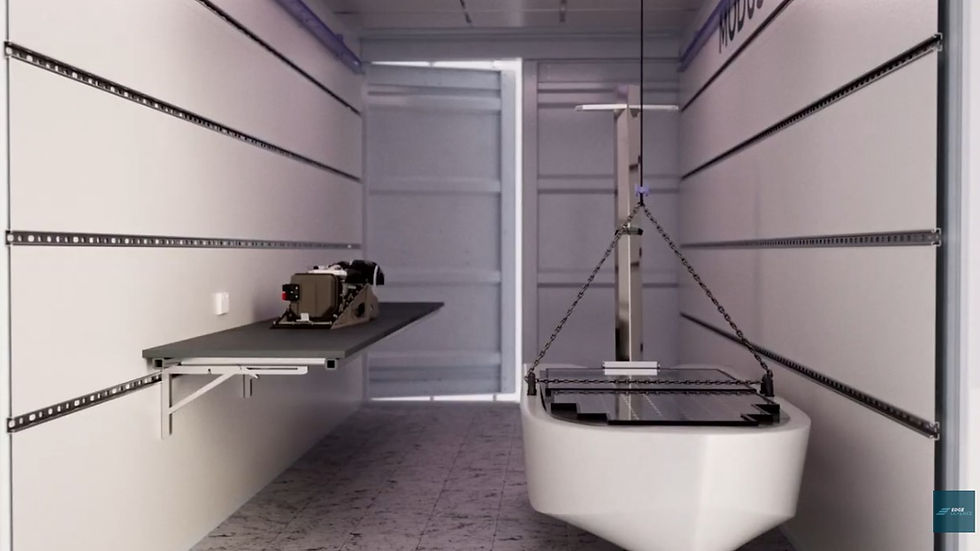
That introduces complexity:
How are multiple USVs deployed into theatre?
How are they powered, maintained, and repaired?
Where does command and control sit?
How do you operate in locations without fixed infrastructure?
This is the gap between prototype and operational capability.
And it is exactly where MODUS SWARM sits.
Introducing MODUS Swarm
MODUS Swarm has been developed alongside WHAI as the deployment and sustainment layer for autonomous systems.

It is a containerised, modular system that enables:
Deployment of multiple autonomous platforms from a single node
Optional integrated command and control (C2)
Optional off-grid power (solar, battery, generator)
On-site maintenance and repair capability
Secure communications and data handling
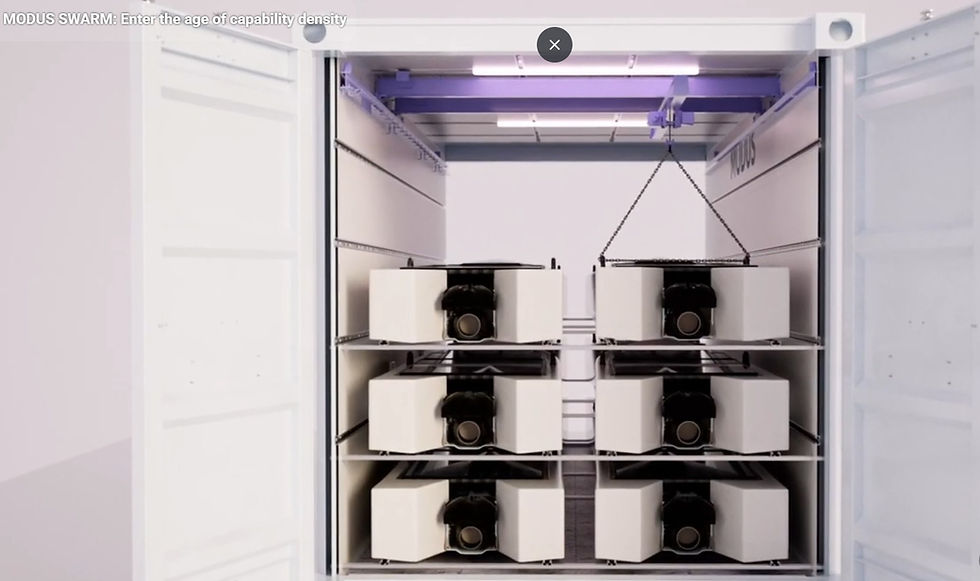
Rather than deploying individual platforms, MODUS Swarm allows operators to deploy a complete, self-sustaining capability system with 12 x USV platforms.
WHAI + MODUS Swarm = Operational Ecosystem
Individually, both systems deliver value.
Together, they form a complete operational ecosystem.
WHAI USV
Delivers low-observable, high-speed, modular maritime capability for ISR and mission payloads
MODUS Swarm
Provides deployment, sustainment, power, and control infrastructure
Combined, they enable:
Distributed ISR across wide maritime areas
Persistent operations through platform rotation and sustainment
Rapid deployment from containerised systems
Reduced reliance on traditional infrastructure and large platforms
In practical terms, this means:
A single 20ft container can deploy, sustain, and control a fleet of autonomous systems in-theatre.
Alignment to the Operating Environment
This ecosystem approach directly reflects the direction of modern defence operations.
Across New Zealand, Australia, and the wider Indo-Pacific, there is a clear shift toward:
Distributed and networked capability
Modular systems that can be rapidly reconfigured
Reduced logistics footprint in remote environments
Increased use of autonomous platforms as force multipliers
WHAI and MODUS Swarm have been designed together to meet these realities-not as future concepts, but as deployable capability available today.
Designed for Austere and Contested Environments
Together, WHAI and MODUS Swarm are designed to operate where traditional systems struggle:
Remote maritime environments
Littoral and coastal regions
Areas with limited or no infrastructure
Contested or degraded logistics environments
Key characteristics include:
Transportable by land, sea, or air
Rapid setup and pack-down
Optional hybrid energy systems for extended endurance
Modular architecture for mission flexibility
This scalable ecosystem allows a model for: NZDF and ADF operations, Pacific maritime security partners, boarder and EEZ monitoring and HADR response scenarios
Conclusion
WHAI demonstrates how quickly autonomous platforms can be developed and deployed.
MODUS Swarm ensures those platforms can be scaled, sustained, and operationalised.
Together, they represent a shift:
From standalone platforms, to integrated, deployable capability ecosystems.

Comments